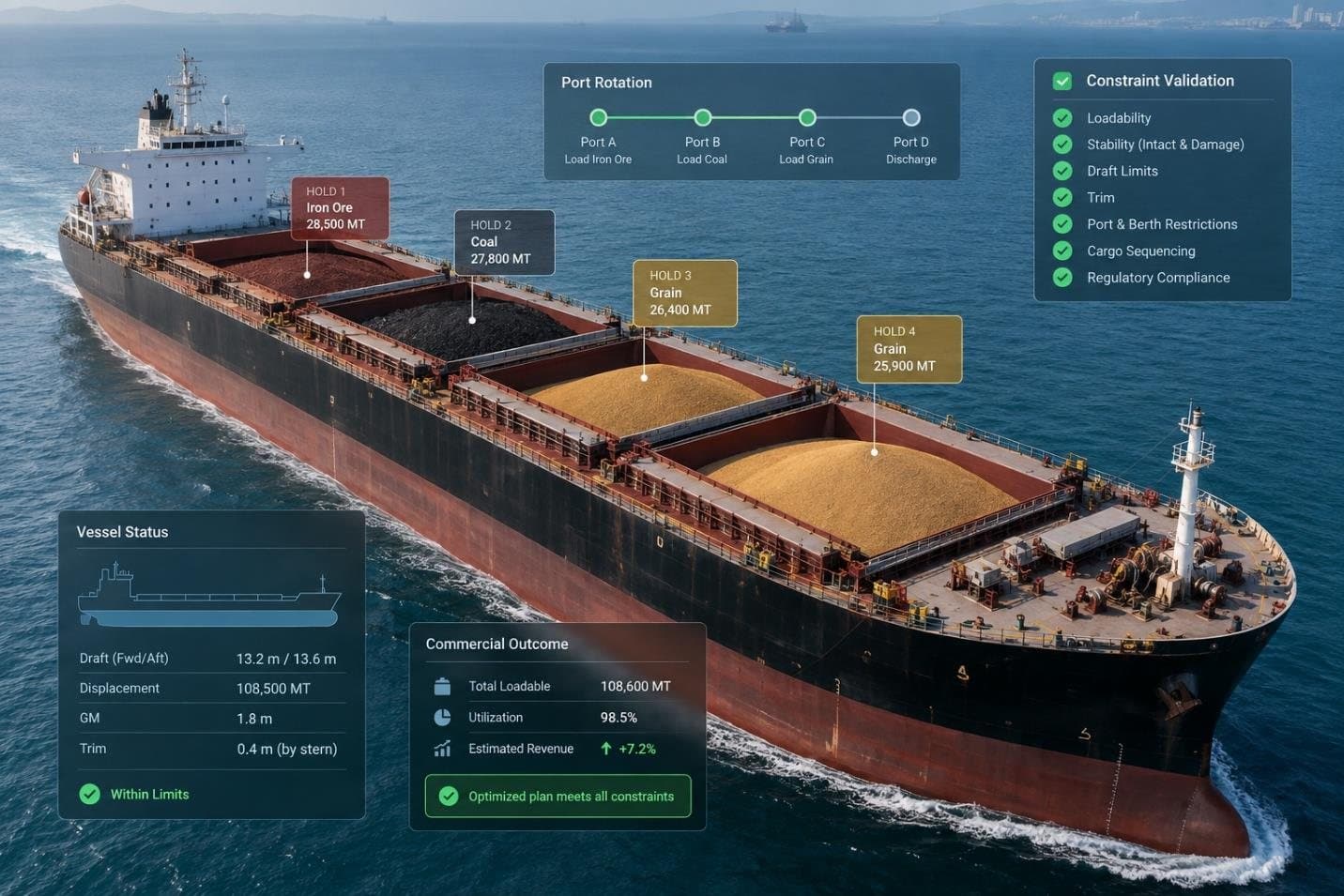
The Commercial Question Before Every Fixture
A cargo opportunity lands on a chartering desk. The counterparty wants a decision quickly. Before anyone commits, the same set of questions has to be answered, in some order, under time pressure:
- Can the nominated vessel carry the required quantity?
- What is the maximum feasible loadable, not the theoretical one?
- Can the plan comply with draft restrictions across the full port rotation?
- If there are multiple grades, how should they be distributed across holds?
- Will the resulting stowage meet stability and structural limits?
- Would a different vessel in the fleet be commercially better suited?
None of these questions are unusual. Every chartering and operations team in dry bulk has worked through some version of them, often several times a day. What makes the moment difficult is not the individual question. It is that all of them have to be answered together, correctly, and fast enough to matter commercially.
A technically correct answer that arrives after the counterparty has moved on is, commercially, no answer at all. Speed is not convenient here. It is part of what determines whether the fixture is won, and on what terms.
This article looks at why that combined question has become harder to answer with traditional methods alone, and how Solverminds BOPT (Bulk Optimizer) approaches it as a single optimization problem rather than a sequence of separate calculations.
Why Traditional Bulk Cargo Planning Is Reaching Its Limits
None of this reflects a lack of expertise. Dry bulk chartering, operations and marine teams carry deep, hard-earned knowledge of vessels, cargoes and trades. The strain comes from how that knowledge has to be applied under current workflows.
In practice, cargo planning today often still involves:
- Spreadsheet-based iterations, rebuilt or adjusted for each new scenario
- Waiting on vessel masters or marine operations to confirm loadability or stability
- Repetitive ship-to-shore and shore-to-ship communication loops
- Multiple cargo-plan revisions as assumptions shift
- Commercial and operational analysis running as separate, sequential exercises
- Slow comparison between candidate vessels or cargo options
- Heavy reliance on the experience of specific individuals to catch what a spreadsheet cannot
Each of these is manageable in isolation. Together, across a busy desk handling several live opportunities at once, they add friction at exactly the moments when friction is costliest.
The issue is not whether experienced planners can solve these problems. The issue is how quickly, consistently and repeatedly those decisions can be made when commercial windows are shrinking.
One Mathematical Problem, Not Three Separate Workflows
BOPT starts from a different premise: vessel, cargo and operational constraints are not three separate checks to run in sequence. They are one interconnected constraint set, and they need to be resolved together.
Vessel, cargo and operational constraints
Vessel constraints
Deadweight and draft limits
Cargo constraints
Cargo grade and density
Operational constraints
Loading and discharge port restrictions
Vessel constraints
Hold and tank capacity
Cargo constraints
Loadable quantity limits
Operational constraints
Loadline zones
Vessel constraints
Ballast and trim requirements
Cargo constraints
Compatibility and segregation requirements
Operational constraints
Arrival and departure conditions
Vessel constraints
Stability parameters, including GM, trim and shear force and bending moment
Cargo constraints
Preferred stowage sequence
Operational constraints
Port rotation
Cargo constraints
Discharge sequence
Operational constraints
Other operational and regulatory requirements
| Vessel constraints | Cargo constraints | Operational constraints |
|---|---|---|
| Deadweight and draft limits | Cargo grade and density | Loading and discharge port restrictions |
| Hold and tank capacity | Loadable quantity limits | Loadline zones |
| Ballast and trim requirements | Compatibility and segregation requirements | Arrival and departure conditions |
| Stability parameters, including GM, trim and shear force and bending moment | Preferred stowage sequence | Port rotation |
| Discharge sequence | Other operational and regulatory requirements |
The complication is that optimizing one of these in isolation can quietly undermine another. Maximizing tonnage in one hold can push trim or stress outside acceptable limits. Sequencing cargo purely for discharge convenience can create a draft problem two ports later. A vessel that looks ideal on deadweight alone may not clear a loadline restriction at a specific point in the rotation.
BOPT resolves vessel, cargo and operational constraints together, rather than sequentially, to produce a load plan that is feasible across all of them at once, not just optimized on the one variable considered last.
Two Desks. One Optimization Engine.
Bulk cargo planning is really two questions, asked by two different desks, about the same voyage.
For Chartering and Commercial Teams, the question is: will this cargo fit safely and commercially on this vessel? For Operations Teams, the question shifts to: what is the best feasible way to load the vessel?
What each desk needs
For Chartering and Commercial Teams
Pre-fixture loadability analysis
For Operations Teams
Hold-by-hold cargo allocation
For Chartering and Commercial Teams
Vessel suitability assessment
For Operations Teams
Multi-grade cargo planning
For Chartering and Commercial Teams
Maximum feasible cargo quantity
For Operations Teams
Multi-port discharge sequencing
For Chartering and Commercial Teams
Cargo quantity evaluation against commercial terms
For Operations Teams
Ballast management
For Chartering and Commercial Teams
Port and draft constraint evaluation
For Operations Teams
Stability validation
For Chartering and Commercial Teams
Comparison across commercial scenarios
For Operations Teams
Vessel and port restriction compliance
| For Chartering and Commercial Teams | For Operations Teams |
|---|---|
| Pre-fixture loadability analysis | Hold-by-hold cargo allocation |
| Vessel suitability assessment | Multi-grade cargo planning |
| Maximum feasible cargo quantity | Multi-port discharge sequencing |
| Cargo quantity evaluation against commercial terms | Ballast management |
| Port and draft constraint evaluation | Stability validation |
| Comparison across commercial scenarios | Vessel and port restriction compliance |
Earlier access to loadability intelligence, before a fixture is confirmed, reduces how often commercial teams need to run preliminary checks through operations or marine, and lets them respond to opportunities with more confidence in the underlying numbers.
BOPT connects these two questions rather than treating them as separate workflows run by separate teams at separate times. The commercial decision and the operational plan draw on the same constraint set, so a scenario that looks commercially attractive has already been checked against the operational reality that would follow.
From Loadability to Optimized Stowage
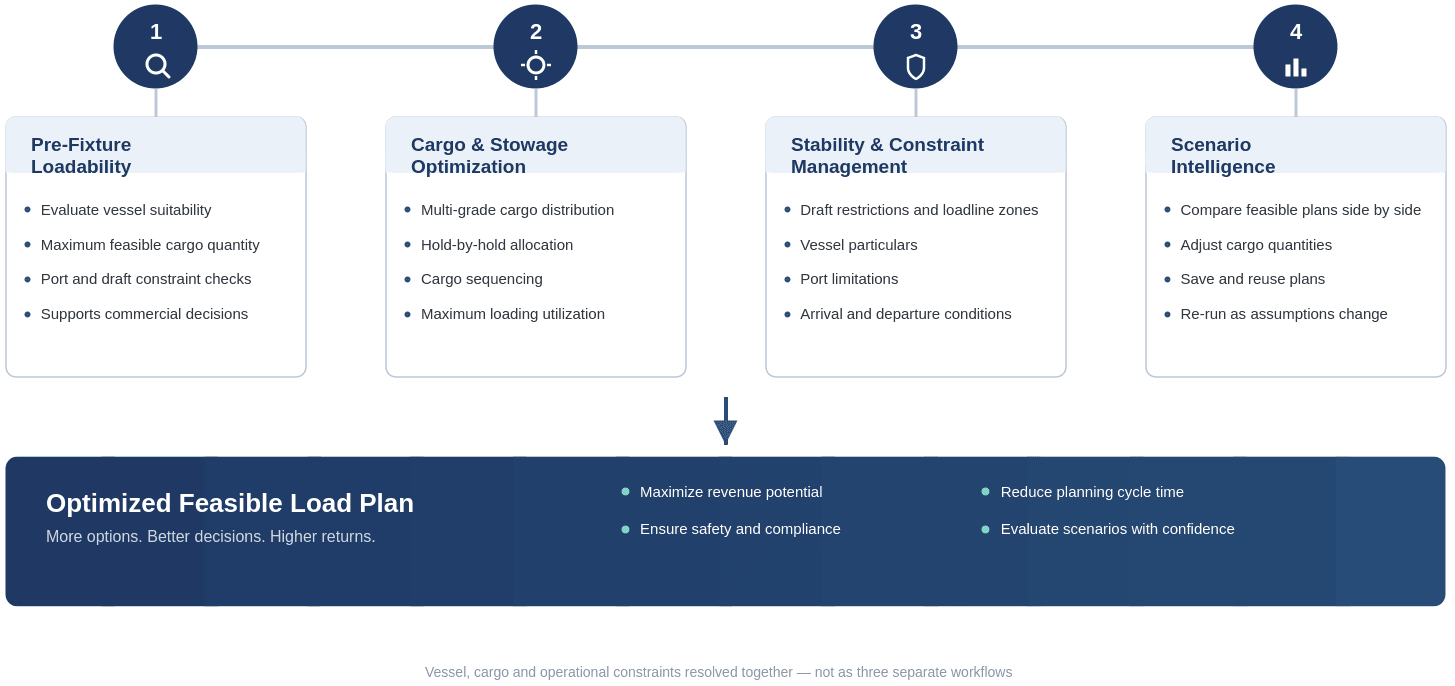
Real-World Scenario: Pre-Fixture Vessel Screening
Consider a 65,000 MT coal cargo, Richards Bay to Rotterdam, with three candidate Panamax vessels under consideration.
BOPT retrieves vessel particulars for each candidate, factors in port draft and seawater density along the rotation, and runs loadability analyses across all three vessels simultaneously rather than one after another. The output is a direct, side-by-side comparison of feasible cargo quantity, ballast requirement and constraint compliance for each vessel.
In this illustrative BOPT scenario, the comparison surfaced a candidate capable of loading around 6% more cargo while carrying roughly 1,000 MT less ballast than the alternatives, with stronger fixture certainty and improved TCE potential as a result. This turnaround happens close to real time, giving the desk enough confidence to commit to the charterer while the fixture window is still open. Final loadable quantities remain subject to the Vessel Master's review and agreement, as is standard practice.
These figures are scenario-specific optimization outcomes, not guaranteed savings for every cargo or vessel combination. What they illustrate is the value of comparing vessels on a common, constraint-checked basis before a fixture is confirmed.
Real-World Scenario: Automated Load Plan and Ballast Optimization
A second scenario involves an iron ore cargo moving from Brazil to China across a multi-port rotation, with more than one cargo grade and a defined stowage factor for each.
BOPT works through the stability and stress constraints across the rotation, optimizes ballast across each leg, and builds a hold-by-hold load plan consistent with the discharge sequence.
In this scenario, the optimized plan reduced ballast water by around 12% and lowered ballast-leg fuel burn by roughly 10%, with a validated plan generated in minutes rather than through repeated manual iteration. By optimizing hull deflection within stress limits, the plan also increased loadable quantity by 600 MT across the voyage.
These are scenario-specific results. They demonstrate what constraint-aware optimization can achieve for a particular voyage, not a fixed performance guarantee across all trades.
From Ship-Shore Loops to Shared Planning Intelligence
The shift BOPT introduces is easiest to see side by side:
Before BOPT and with BOPT
Before BOPT
Repetitive ship-shore workflows causing delays
With BOPT
Streamlined ship-shore workflows enabling faster decisions
Before BOPT
Spreadsheet-based iteration for every scenario
With BOPT
Constraint-based optimization run centrally
Before BOPT
Dependency on vessel masters and marine operations for confirmation
With BOPT
Repeatable planning intelligence, available on demand
Before BOPT
Multiple cargo-plan revisions as assumptions shift
With BOPT
Optimized scenarios generated in minutes
Before BOPT
Slow comparison of alternative vessels or cargoes
With BOPT
Rapid, side-by-side comparison between options
Before BOPT
Commercial and operational analysis run separately
With BOPT
A shared planning environment used by both teams
| Before BOPT | With BOPT |
|---|---|
| Repetitive ship-shore workflows causing delays | Streamlined ship-shore workflows enabling faster decisions |
| Spreadsheet-based iteration for every scenario | Constraint-based optimization run centrally |
| Dependency on vessel masters and marine operations for confirmation | Repeatable planning intelligence, available on demand |
| Multiple cargo-plan revisions as assumptions shift | Optimized scenarios generated in minutes |
| Slow comparison of alternative vessels or cargoes | Rapid, side-by-side comparison between options |
| Commercial and operational analysis run separately | A shared planning environment used by both teams |
None of this replaces the maritime professionals running the process. It removes the repetitive calculation loops that currently absorb their time, so that expertise can be applied to the judgment calls that genuinely require it.
Conclusion: Know What Fits Before You Commit
Bulk cargo planning has always required balancing commercial opportunity against operational reality. What has changed is the number of variables involved, the pace at which decisions need to be made, and the cost of getting the sequence of checks wrong.
Know what fits before you commit. Optimize how you load before you sail.
As constraint-aware optimization becomes a standard part of how bulk shipping organizations plan, those able to evaluate more scenarios, compare vessels faster, and standardize planning quality across their teams will increasingly operate from a stronger commercial position. It also means institutional knowledge no longer has to live in any one planner's head, and cargo volumes can grow without a matching increase in manual workload.