Every liner planner knows the feeling. The schedule looks fine on paper. The vessel is full. And yet, at the end of the voyage, the numbers don't quite add up the way they should.
That gap — between a plan that looks efficient and a voyage that is actually profitable — is where liner shipping's next competitive advantage is being decided.
The Growing Complexity of Liner Planning
Liner planning has never been a single decision. It is dozens of decisions, made continuously, that all pull against each other.
Commercial teams want vessel utilization and cargo contribution. Operations teams are managing bunker costs, vessel opex, and schedule reliability. Every port call brings its own draft, berth, and equipment constraints.
Add empty container repositioning, slot-sharing arrangements with alliance partners, and freight rates that move faster than any planning cycle — and the picture gets harder to hold in one view.
Each of these variables is manageable on its own. The difficulty is that they interact — a decision on one trade lane changes the economics of another.
The cost of getting this wrong is not trivial. Industry analysis points to inefficient fleet and service management shaving 3-5% off a shipping line's annual profitability, through a combination of underutilized cargo space, suboptimal vessel deployment, misaligned bunker procurement, and slow reactions to market shifts.
A Full Vessel Is Not Necessarily a Profitable Vessel
There is a persistent assumption in liner shipping: if the vessel is full, the voyage has done its job.
But utilization is a measure of activity, not value. A vessel loaded to capacity with low-contribution cargo can generate less profit than a vessel sailing with room to spare, carrying the right mix.
The real driver of profitability is cargo selection — weighed against contribution, port pair, equipment type, weight, available capacity, and the true cost of carrying that cargo on that leg.
Two vessels on the same service, carrying different cargo combinations across the same port pairs, can post very different contribution results — even at similar utilization levels.
Moving from Reactive Planning to Optimization
Much of liner planning today is still reviewed after the fact. A voyage is planned, executed, and only then assessed for how well it performed.
By the time that review happens, the opportunity to have chosen differently has already sailed — literally.
The alternative is to evaluate alternative scenarios before committing a schedule: different vessels, different cargo mixes, different port sequencing — compared on contribution, cost, and utilization, side by side.
This is the shift from reactive planning to optimization: not replacing the planner's judgment, but giving it a wider set of tested options to choose from.
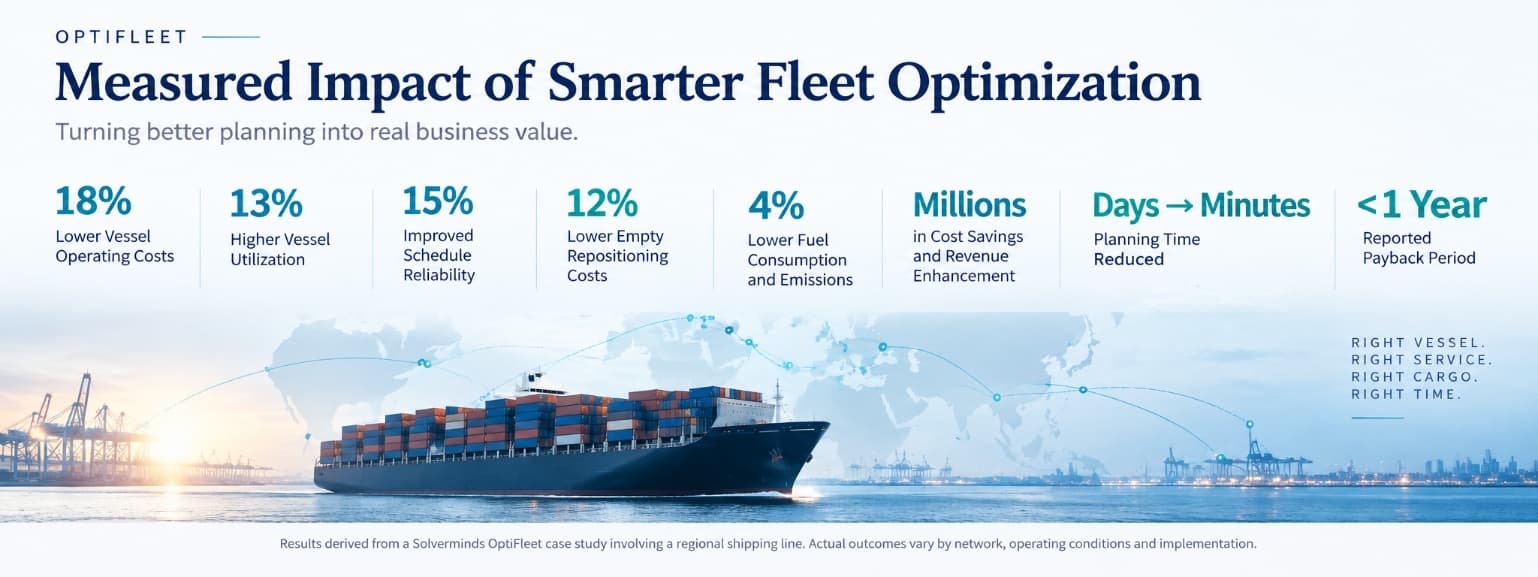
It is also a shift in speed. Planning cycles that once took days to rework — re-running a network scenario, reassessing a schedule after a disruption — now run in a fraction of the time. A full network re-optimization typically completes within 1–2 hours; a single voyage or schedule-level re-optimization can return in minutes. That difference matters commercially: a berth delay, a demand spike, or a rate change can be re-evaluated and acted on the same day, not the following week.
Where OptiFleet Fits
OptiFleet, developed by Solverminds, is a fleet, service, and cargo optimization platform built for exactly this problem. It brings the interconnected decisions of liner planning — vessel deployment, service design, cargo selection, and cost — into one optimization environment, rather than treating each as a separate exercise.
Its capabilities group into five commercial themes:
- Profitability-first deployment and cargo planning. Vessel deployment, service and voyage planning, and cargo optimization are evaluated together, so the platform can compare which vessel-cargo combination earns the most, not just which fills the most space.
- Network design and route optimization. Beyond individual voyages, OptiFleet can help re-evaluate port rotations, service structures, and network-level trade-lane design — testing how a redesigned route or a different port sequence would perform before it is committed to the live network.
- Scenario evaluation and utilization. Planners can run scenario-based vessel scheduling and utilization analysis before a plan is locked in, comparing voyage and service profitability across options.
- Network-level flexibility. Slot-sharing planning, feeder optimization, empty container stock considerations, and NVOCC capacity planning are handled within the same framework — reflecting how modern liner networks actually operate, across owned tonnage, chartered capacity, and partner arrangements.
- Sustainability and simulation. CII and emissions visibility sit alongside the commercial variables, and what-if simulations let planners test disruption scenarios — port congestion, a vessel delay, a schedule change — and see the financial consequence before deciding how to respond.
How the Optimization Works
Strip away the terminology, and the process is straightforward:
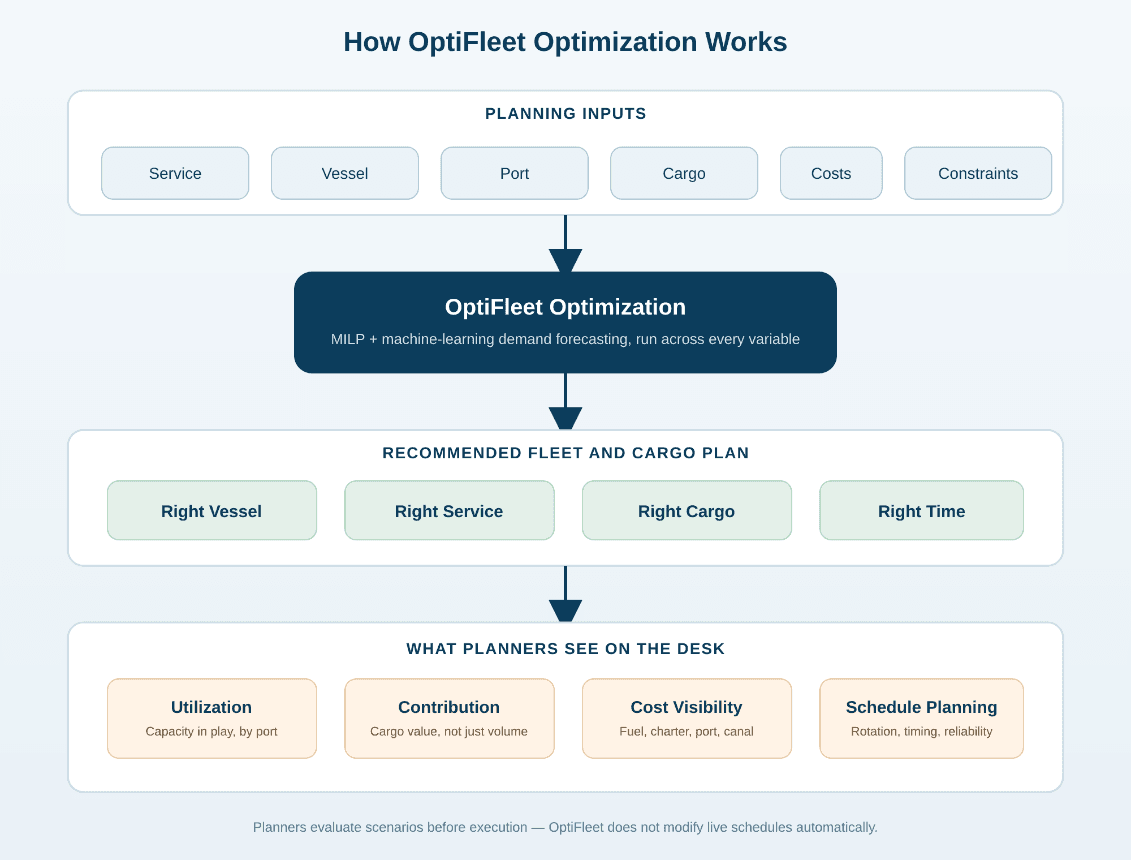
Underneath, the platform combines mixed-integer linear programming with machine-learning demand forecasting — solving for the combination of vessel, cargo, and routing decisions that maximizes contribution, not just one variable in isolation.
Before committing to a schedule, planners can see what cargo to target, how much to accept, which vessel best serves the voyage, which port pairs carry the strongest contribution, and the utilization and cost outcome each option implies.
Planners still evaluate and approve the plan — OptiFleet does not alter live schedules automatically. It rebuilds and re-scores scenarios on request, so a revised plan can be reviewed and applied by the team.
Strategic Planning Meets Operational Optimization
OptiFleet is built to support two distinct planning perspectives, rather than forcing both into the same lens.
Two planning perspectives
Strategic Optimization
Evaluates services, vessel choices, port rotations, historical cargo patterns, and full network design to test alternative network scenarios — useful when considering a new trade lane, a service redesign, a change in vessel class, or a broader redesign of the network itself.
Operational Optimization
Works within an established liner service, optimizing cargo allocation, vessel utilization, cost, and profitability voyage by voyage, as demand and conditions shift.
| Strategic Optimization | Operational Optimization |
|---|---|
| Evaluates services, vessel choices, port rotations, historical cargo patterns, and full network design to test alternative network scenarios — useful when considering a new trade lane, a service redesign, a change in vessel class, or a broader redesign of the network itself. | Works within an established liner service, optimizing cargo allocation, vessel utilization, cost, and profitability voyage by voyage, as demand and conditions shift. |
Together, they give commercial and operations leadership a shared basis for both long-range network decisions and week-to-week execution calls.
Connecting OptiFleet with SONATA
Fleet and cargo optimization answers one question: what should this voyage carry, and on which vessel? Stowage planning answers a different one: can this specific cargo actually be loaded, safely and within vessel limits?
That is where SONATA, Solverminds' stowage optimizer, complements OptiFleet.
OptiFleet Optimized Cargo Plan → SONATA Stowage Feasibility Validation → Accepted/Rejected Cargo Feedback → Executable Planning
OptiFleet operates at the fleet, service, voyage, and cargo level. SONATA validates that plan against stability, stress, lashing, and stack-load constraints at the container level — confirming what can actually be executed on board.
From Planning Decisions to Commercial Outcomes
Brought back to the priorities of commercial and operations leadership, the case for optimization rests on a few consistent outcomes:
- Higher Utilization — better use of available vessel capacity, not just fuller vessels.
- Stronger Contribution — cargo selected for commercial value, not volume alone.
- Greater Cost Visibility — vessel, fuel, port, and charter economics understood before execution, not reconstructed afterward.
- Faster Decision-Making — multiple scenarios compared before a plan is committed, with full network re-optimization in 1–2 hours and schedule-level re-optimization in minutes — turning planning cycles that once took days into same-day decisions.
- Commercial and Operational Alignment — one decision framework shared by both teams, rather than two separate views of the same voyage.
- Sustainability Visibility — fuel consumption, emissions, and CII considered alongside commercial objectives, not bolted on afterward.
Conclusion: From Reactive Planning to Decision Intelligence
Cargo demand will keep shifting. Freight rates will keep moving. Bunker costs, port constraints, and service disruptions aren't going away — if anything, they're becoming more frequent.
What increasingly separates one liner operator from another isn't access to data. It's how quickly they can weigh that data against every other moving variable and identify the strongest available plan — before the voyage sails.
Right Vessel. Right Service. Right Cargo. Right Time.
That is where optimization turns planning into commercial advantage — faster than ever.