The industry has digitized almost everything, except this
The container shipping industry has made significant strides in digitizing vessel operations, terminal visibility, and logistics coordination. Tracking systems, port management platforms, and freight booking engines have all been transformed by software over the past two decades. Yet one critical operational domain has lagged conspicuously behind: Maintenance & Repair.
M&R operations: the workflow that governs how a damaged container is surveyed, estimated, approved, repaired, and billed, continue to run on paper forms, spreadsheets, email chains, and disconnected tools. The result is a process riddled with delays, errors, disputes, and invisible costs that compound quietly every day across every depot.
At its core, the problem is not a lack of data. It is a lack of connected, actionable intelligence. Survey data exists, but it does not flow to estimation. Estimates are created, but they are not automatically validated against tariffs. Approvals are granted, but they live in inboxes rather than systems. Every transition between stages is a manual act, and every manual act is a potential failure point.
This article examines the structural failures of legacy M&R operations, explores the architecture of the Solverminds M&R System, and presents a data-driven case for why the transition from fragmented processes to a connected system is one of the highest-return operational investments available to container depot operators today.
“A repair that takes 2 hours to execute can take 72 to 120 hours to authorise. The inefficiency is not in the workshop, it is in the workflow.”
Six failures that define legacy M&R operations
Every container that returns from a voyage enters a workflow that should be swift and decisive. In legacy depot operations, it is anything but. These six structural failures are not isolated incidents, they are systemic conditions that compound daily across every depot, region, and operator still running M&R on manual rails.
The headline numbers are stark: 3–5 days of average idle dwell per damaged container, a 12–15% industry-wide estimate rejection rate, and roughly $95 of cost leakage per container from decision latency alone.
- Decision latency & dwell time: a 2-hour repair takes 72–120 hours to authorise; containers sit idle 3–5 days at $20–$50/day in lost leasing revenue.
- Fragmented & manual workflows: six roles, six systems (or none): paper forms, Excel, email, verbal job cards. Managers lose 3+ hours a day to routine approvals.
- Lack of connected intelligence: a gate-in scan doesn't trigger a survey; a survey doesn't auto-generate an estimate. Every step is a manual relay, and every relay is a delay.
- Damage identification ambiguity: subjective text like 'dent on left panel' doesn't map to tariff codes, driving a 12–15% rejection rate through inconsistent documentation.
- Pricing & tariff errors: manual tariff lookups against large datasets create systematic pricing inconsistencies, rework cycles and multi-day delays.
- Administrative cost & invoice disputes: month-end billing reveals missing approvals and mismatched records, with no structural mechanism to prevent recurrence.
How the Solverminds M&R System works
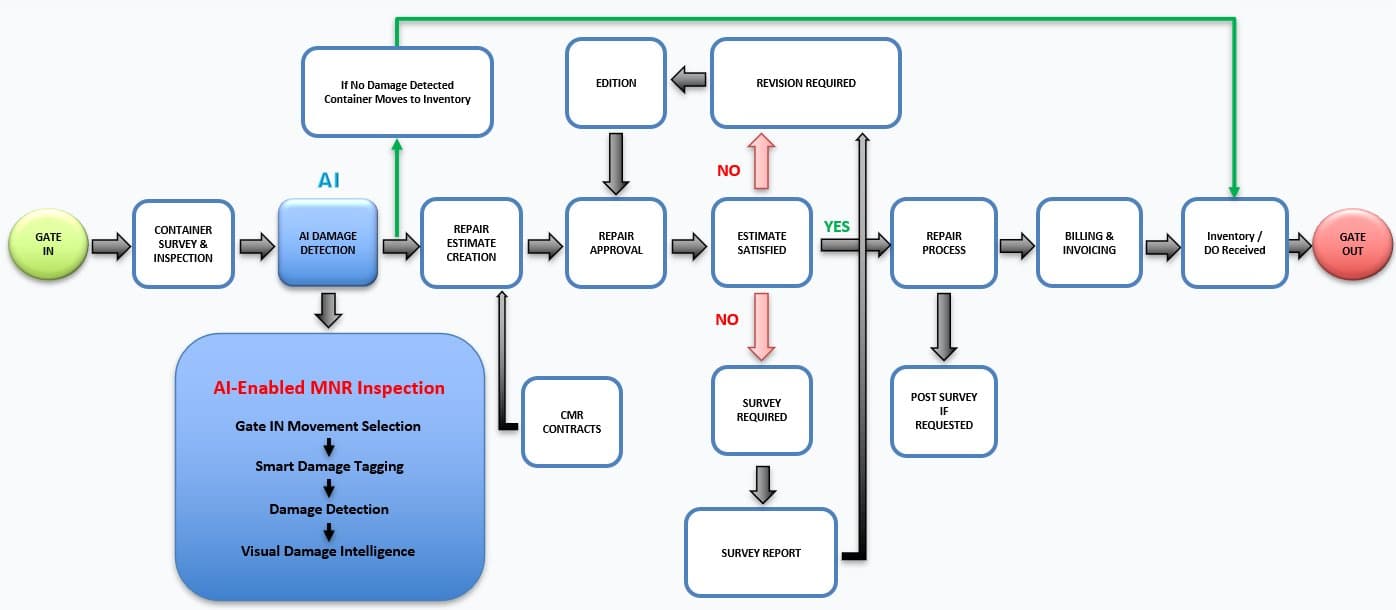
A Solverminds M&R System is not simply a digitized version of the existing process. It is a fundamentally re-architected workflow, one where data captured in the field automatically triggers downstream actions, AI analysis replaces manual interpretation, and every stage is connected to every other stage within a single operational framework.
It introduces this model through a structured, seven-stage workflow that bridges mobile field operations with depot management systems, ensuring continuity, traceability, and control at every step.
- 1 · Container gate-in & survey initiation, the surveyor starts the inspection in the M&R mobile app: no paper, no separate login, no manual logging of container details.
- 2 · Structured image capture: the app enforces a standardized capture format, ensuring consistent data input across all surveyors and locations.
- 3 · AI-assisted image processing: AI detects and classifies damage zones, extracts container identifiers via OCR, and maps damage types to standard repair codes.
- 4 · Estimate preparation: a structured estimate is generated from detected damage and principal-specific tariff logic, eliminating manual lookup errors at source.
- 5 · Workflow-based approval: configurable routing with auto-approval thresholds by repair type, value, liner and depot, so routine repairs never queue.
- 6 · Repair execution: approved repairs run in the ERP; technicians receive digital work orders, not verbal briefings or missing job cards.
- 7 · Quality control & billing: post-repair QC happens in-system; on sign-off, invoices auto-generate matched to the approved estimate, with the tariff version stamped on every record.
Legacy operations vs. the connected M&R model
The following comparison maps key operational metrics across legacy M&R processes and the Solverminds M&R System. Every metric reflects a measurable shift, not a projection, but a consequence of connecting what was previously disconnected.
For depots operating at scale, the move from manual coordination to a connected workflow can significantly reduce inefficiencies, improve turnaround visibility, and enhance financial control. Actual outcomes depend on operational setup and configuration.
- Survey-to-estimate time: legacy 45–90 min (manual) → significantly reduced via AI-assisted image processing and structured capture.
- Estimate-to-approval time: legacy 72–120 hrs (email queue) → streamlined via workflow-based routing and configurable approvals.
- Total repair turnaround: legacy 3–5 days → accelerated via connected workflows and reduced decision latency.
- Estimate rejection rate: legacy 12–15% (tariff errors) → reduced via standardized capture and system validation.
- Routine approval handling: legacy 0% automated → partially automated via configurable rules and value thresholds.
- Invoice accuracy: legacy ~85% (manual errors) → improved via system-driven validation against approved estimates.
- Days sales outstanding: legacy 45–55 days → optimized via faster billing cycles and traceability.
- Audit trail: legacy reconstructed from emails → maintained as a structured, system-driven event log.
- Cost leakage per container: legacy ~$95 (decision latency) → reduced via faster decisions and process efficiency.
- Annual value at 5,000 repairs: legacy $475,000+ leakage → a potential reduction in operational leakage at scale.
Three perspectives from the depot floor
The most effective way to understand what a connected M&R system changes is to trace the day of the people who work within the old one. The system was designed by studying what actually happens in the depot yard, not what the process diagram says should happen.
- LINWAS · depot surveyor (South Asia, 15–20 inspections/day), before: 45 minutes of paperwork per repair, photos on a personal phone, and rejection loops on containers already moved twice. Now: opens the app, points the camera, AI assigns damage codes, submitted in under 5 minutes, no paper, no email.
- SOPHIE · regional M&R manager (12 depots, 3 countries), before: 34 estimate PDFs every Tuesday and 3.5 hours on routine approvals before any strategy. Now: 60–70% of routine approvals clear automatically; her dashboard surfaces only decisions that need judgement.
- LINALS · depot billing executive: before: month-end reconciliation crises, untraceable approvals, disputes, DSO at 45–55 days. Now: no repair closes without a traceable approval; invoices auto-generate on QC sign-off, matched to the estimate with the tariff version stamped.
Calculating the true cost of inaction
The financial case for modernizing M&R operations is not theoretical. Every dollar of latency cost and administrative waste described here is recoverable, and recovery begins the moment a connected system goes live.
The true cost of a damaged container is not just the repair invoice. The industry-standard Total Recovery Cost (TRC) formula captures the full picture of what poor M&R process design costs an operator on every repair:
Total Recovery Cost formula
TRC = Crepair + (Tdwell × Oloss) + Cadmin + Cfriction
What the maths shows: a single $180 floor patch
Applied to a routine floor patch: a common, low-complexity repair, the gap between legacy process cost and the connected model becomes concrete.
“At 5,000 repairs per year, the recoverable leakage under a legacy process exceeds $425,000 annually, not from the cost of repairs, but from the cost of the process around them.”
- Direct repair cost: $180 legacy / $180 connected (identical).
- Dwell: 4 days legacy / 1 day connected.
- Opportunity loss (days × $20): $80 legacy / $20 connected.
- Admin & email time: $25 legacy / $0 connected.
- Billing dispute allocation: $0–$20 legacy / $0 connected.
- Total Recovery Cost: $285+ legacy / $200 connected, a saving of $90+ per container.
- At depot scale: ~$95,000 leakage/yr at 1,000 repairs, ~$285,000 at 3,000, and $475,000+ at 5,000, of which $425,000+ is recoverable.
What a Solverminds M&R System must deliver
Not all M&R software is equal. A system that digitizes forms without connecting them to downstream workflows simply moves the bottleneck rather than removing it. These capabilities define a genuinely transformative platform.
- AI-based damage detection: AI processes survey images to detect damage and identify container details, removing ambiguity, re-submissions and subjectivity.
- Embedded decision support: principal-specific tariff rules baked into estimation; auto-approval thresholds configurable per liner, depot and container type.
- End-to-end connected workflow: every stage from survey to billing is digitally linked; one system replaces six disconnected tools.
- Real-time operational visibility: all stakeholders work on a unified data layer for faster escalation and informed decisions.
- Digitally controlled billing: invoices generated from approved estimates, so discrepancies are prevented rather than discovered at month-end.
- OCR-based contract digitization: upload vendor contracts as PDF, extract structured data, validate against master data, and detect duplicates.
From damage to decision: closing the gap
Maintenance and repair operations sit at the intersection of container availability, operational efficiency, and revenue realization. For too long this domain has been treated as an administrative function rather than a strategic one, a back-office workflow rather than a value-generating process.
The evidence makes the case clearly: the cost of inaction in M&R is not an abstract risk. It is a quantifiable, recurring leakage that accumulates with every idle container, every delayed approval, every manual tariff lookup, and every disputed invoice.
The Solverminds M&R System does not simply speed up existing workflows. It restructures them, connecting every stage, eliminating manual relay points, and giving every stakeholder the information and authority to act at the right moment.
“The future belongs to those who can fastest restore a damaged container to revenue-generating status.”